
A leaking water line rarely announces itself. In Miami, a pinhole leak in a buried service line can soak sandy soil for weeks before a wet spot, a spiking water bill, or soft drywall gives it away. Fast water line repair is what separates a small spot fix from a slab, flooring, and mold claim. In South Florida humidity, trapped moisture becomes mold faster than most homeowners expect.
On recent service calls across Miami, we’ve traced “mystery” bill increases to cracked galvanized service lines, failed copper joints, and burst toilet supply hoses. Each one started small. Each one got more expensive with every week it ran.
Key Takeaways
- Run the two-hour meter test first: Turn off every fixture, note your meter reading, and check it again two hours later. Any movement means water is escaping somewhere on your side of the meter.
- You own everything past the meter: The Miami-Dade Water and Sewer Department (WASD) maintains the public main. The service line from the meter to your house is your responsibility. A documented concealed leak may qualify you for a bill adjustment.
- Pipe material decides repair vs. replace: One clean break in copper or PEX calls for a spot fix. Repeat failures in galvanized, polybutylene, or brittle CPVC mean the whole run has reached the end of its life.
What Counts as a Water Line in a Miami Home?
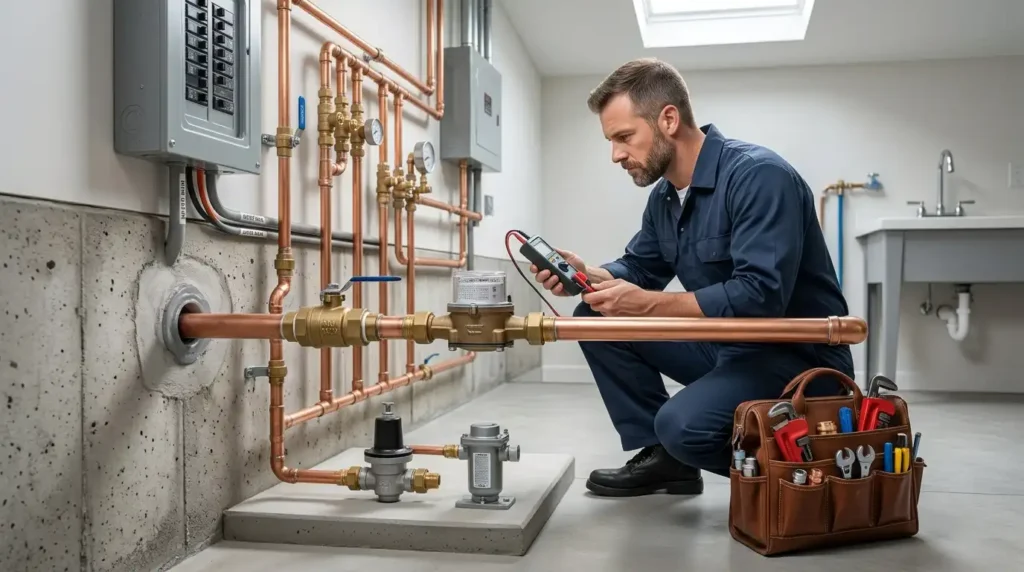
A water line is any pressurized pipe that carries clean drinking water to your fixtures. Your home has four distinct segments, and each one has a different owner, failure pattern, and fix. Knowing which segment failed tells you who pays, who repairs it, and whether water line repair needs a permit.
| Segment | Where It Runs | Who Owns It | Most Common Failure |
|---|---|---|---|
| Public water main | Under the street to your meter | Miami-Dade WASD or your city utility | Main breaks (report to the utility) |
| Service line | Meter to the house entry point | Homeowner | Corrosion, root damage, cracked joints |
| Interior distribution | Walls, attic, or under the slab | Homeowner | Pinhole leaks, slab leaks |
| Fixture supply lines | Shutoff valve to toilet, faucet, or shower | Homeowner | Burst braided hoses, seized valves |
| Condo risers | Vertical pipes serving multiple units | Condo association (usually) | Riser corrosion, failed unit valves |
Miami-Dade County maintains more than 8,500 miles of underground water lines serving about 2.4 million residents. Your responsibility starts at the meter. Everything downstream, from the buried run in your yard to the braided hose behind your toilet, is yours to maintain.
At Miami Bathroom Plumbing Services, we start every call by identifying the segment before quoting a price. A wet yard and a wet bathroom ceiling look like the same problem on a bill. They need completely different repairs.
Warning Signs of a Failing Water Line
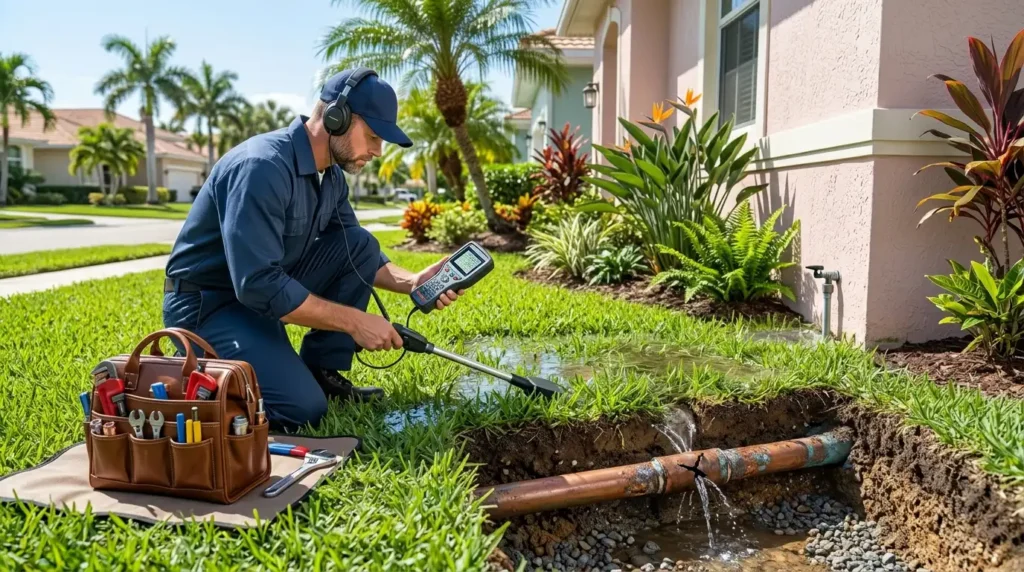
A failing water line shows up in your bill, your water pressure, or your yard before it shows up as a flood. Our Local Gov Certified plumbers frequently see homeowners ignore these signs for two or three billing cycles. That delay is where the real damage happens.
Watch for these signs:
- A higher bill with no change in usage. This is the most reliable early signal.
- Low pressure at multiple fixtures. One weak faucet points to a fixture. Weak flow everywhere points to the line.
- Wet, soft, or unusually green patches in the yard, especially between the meter and the house.
- The sound of running water when every fixture is off.
- Warm spots on tile floors. This often signals a hot-water slab leak.
- Rusty, brown, or cloudy water from galvanized or corroded pipes.
- Cracks in the slab or baseboards that appear without settling elsewhere.
- Musty odors behind vanities, toilets, or shower walls.
| Warning Sign | What It Usually Means | Urgency |
|---|---|---|
| Meter moves with all fixtures off | Active leak on your side of the meter | High: call within 24 hours |
| Wet yard between meter and house | Service line break | High |
| Warm floor tile | Hot-water slab leak | High |
| Low pressure throughout the home | Service line leak, restriction, or failed PRV | Medium to high |
| Rusty water at every tap | Corroding galvanized pipe | Medium (plan replacement) |
| Hissing behind a toilet | Failing supply line or fill valve | Medium |
| Water stain on a bathroom ceiling | Leak in the floor or unit above | High |
The meter test below confirms what these signs suggest.
Why Miami Water Lines Fail Sooner
Miami’s environment shortens pipe life. Salt, sand, limestone, and heat all attack buried and concealed pipes faster than inland conditions do. If you’ve spent a summer in Miami, FL, you already know how fast moisture and corrosion work here. Your pipes deal with the same conditions year-round, underground.
| Miami Factor | How It Damages Pipes | Where We See It Most |
|---|---|---|
| Salt-laden soil and high water table | Speeds corrosion on copper and galvanized lines | Miami Beach, Surfside, Key Biscayne, Sunny Isles |
| Sandy, shifting soil | Stresses rigid joints until they crack or separate | Coastal and newer fill neighborhoods |
| Oolitic limestone (coral rock) | Sharp rock abrades buried pipe and complicates digging | Coral Gables, Coconut Grove, South Miami-Dade |
| Slab-on-grade construction | Puts supply pipes under concrete, hiding leaks | Most single-family homes countywide |
| Mineral-rich aquifer water | Leaves scale in aging pipes, valves, and cartridges | Older homes with original plumbing |
| Ficus and banyan roots | Crush or shift buried service lines | Older tree-lined streets |
| High static pressure (over 80 psi) | Constant stress on joints, hoses, and valves | Homes without a working pressure-reducing valve |
| Aging materials | Galvanized and polybutylene past service life | Homes built from the 1950s through the mid-1990s |
These factors stack. A 1970s Kendall home with polybutylene under the slab and no pressure-reducing valve (PRV), a valve that caps incoming pressure, carries far more risk than a newer Doral home with PEX.
Our bathroom plumbing services include pressure testing, PRV replacement, and supply line upgrades designed around these Miami-specific stresses. A $20 pressure gauge on your hose bib tells you whether pressure is part of the problem.
Troubleshooting Steps Before You Call
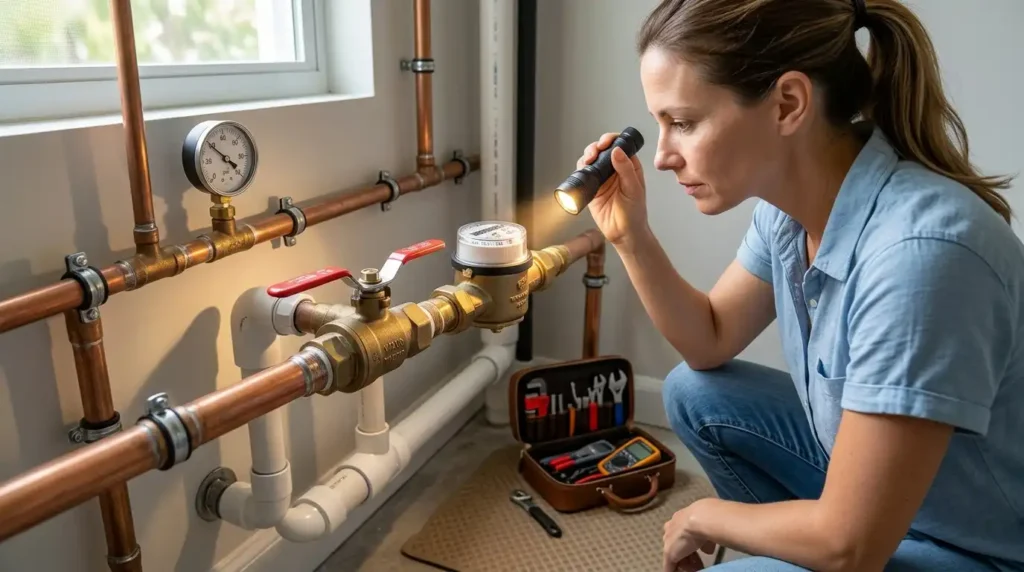
The meter test is the fastest way to confirm a hidden leak. It costs nothing and takes two hours. The EPA Water Sense Fix a Leak resources recommend this exact method, and it works on every Miami-Dade residential meter.
- Turn off every fixture and appliance. This includes irrigation, the ice maker, the washer, and the pool fill.
- Read your meter. Note the full reading and watch the low-flow indicator (the small triangle or star dial). If it spins, water is moving.
- Wait two hours. Use no water during this window.
- Read the meter again. Any change means you have a leak.
- Close your home’s main shutoff valve and repeat the test. If the meter still moves, the leak is in the service line between the meter and the house. If it stops, the leak is inside the home.
- Dye-test every toilet. Add a few drops of food coloring to the tank. Color in the bowl after 10 minutes means a leaking flapper.
- Inspect fixture supply lines. Check under sinks, behind toilets, and at the water heater for drips, bulges, or rust.
- Walk the service line route. Look for wet soil, sinking pavers, or green strips from the meter to the house.
| Meter Test Result | Likely Leak Location | Next Step |
|---|---|---|
| Meter moves, house shutoff open | Somewhere on your property | Close the house shutoff and retest |
| Meter moves, house shutoff closed | Buried service line | Schedule electronic leak detection |
| Meter stops when house shutoff closes | Interior plumbing | Check toilets, supply lines, then slab |
| Dye appears in toilet bowl | Worn flapper or flush valve | Replace the flapper |
| Meter steady, bill still high | Irrigation, pool, or billing issue | Check irrigation zones and pool autofill |
Leaks add up fast. The EPA reports that the average household’s leaks waste more than 9,300 gallons a year, and nine percent of homes have leaks wasting 50 gallons or more per day. Fixing easily corrected leaks saves homeowners about 10 percent on water bills.
| Leak Type | Water Wasted | What That Means |
|---|---|---|
| Faucet dripping once per second | 3,000+ gallons per year | Enough for 180+ showers |
| Showerhead at 10 drips per minute | 500+ gallons per year | About 60 dishwasher loads |
| Household leak of 50 gallons per day | 1,500 gallons per month | A noticeable jump on every bill |
| Irrigation leak 1/32 inch wide | About 6,300 gallons per month | Often mistaken for a service line leak |
Write down your meter readings. They help us pinpoint the problem faster and support a bill adjustment request later.
What Miami Homeowners Pay for Line Repairs
Price depends on access, length, and material. When homeowners search “water line repair cost Miami,” they usually want one number. The honest answer is a range, and the biggest variable is what sits on top of the pipe. A leak under grass costs less to reach than one under a paver driveway or a tiled bathroom floor.
| Job | Typical Miami Range | What Drives the Price |
|---|---|---|
| Electronic leak detection | $150 to $450 | Property size, slab vs. yard |
| Toilet or faucet supply line replacement | $125 to $300 | Number of fixtures, valve condition |
| Angle stop (shutoff valve) replacement | $150 to $350 | Copper vs. CPVC stub-out |
| Spot repair, accessible interior pipe | $250 to $800 | Wall or ceiling access and patching |
| Spot repair, buried service line | $500 to $1,800 | Depth, coral rock, surface restoration |
| Full service line replacement (30 to 60 ft) | $1,800 to $5,500 | Length, material, driveway crossing |
| Trenchless service line replacement | $2,500 to $6,500 | Soil type, entry points, length |
| Slab leak repair (through the floor) | $1,500 to $4,500 | Tile type, location, restoration |
| Reroute around the slab | $1,200 to $3,500 | Distance, attic or wall path |
| Whole-home repipe (PEX, two baths) | $5,000 to $15,000 | Home size, fixture count, drywall repair |
| Permit fees | Varies by city | Scope and jurisdiction |
These ranges reflect typical estimates, not a quote. We give you a written, upfront price after we locate the leak, so you approve the number before any work begins.
Three things that raise your price:
- Coral rock at shallow depth, which requires breakers instead of shovels
- Paver or concrete driveways over the line route
- Brittle CPVC that cracks in new spots while we repair the original one
Three things that lower it:
- Early detection before soil erosion or slab damage
- Clear access to the meter and house shutoff
- A single isolated break in otherwise sound pipe
Pipe Material Lifespan in Miami Conditions
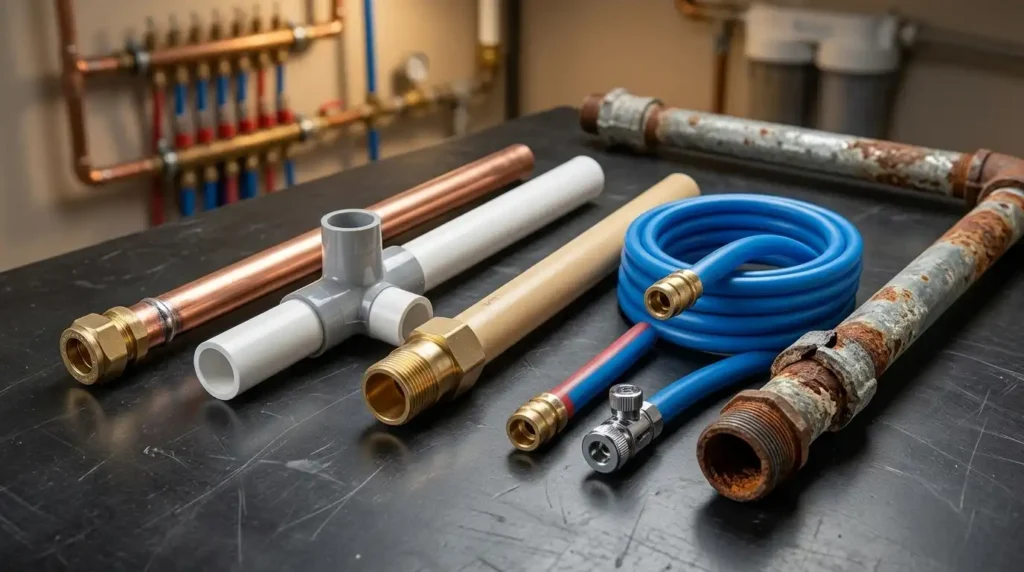
Pipe material determines how long your line lasts and how it fails. Manufacturer lifespans assume ideal conditions. Miami conditions are rarely ideal. Our crews regularly find copper pinholes decades ahead of schedule near the coast and CPVC that shatters at a touch after years in a hot attic.
| Material | Rated Lifespan | Miami Performance | Best Use |
|---|---|---|---|
| Copper Type L | 50 to 70 years | Pinhole leaks can appear early near salt and aggressive soil | Interior supply, above-grade transitions |
| Copper Type K | 50+ years | Thicker wall resists burial stress better | Underground service lines |
| PEX | 40 to 50 years | Flexible, fewer joints, handles soil movement; degrades in sunlight | Underground runs, repipes, reroutes |
| CPVC | 50 years (rated) | Turns brittle with heat and age; cracks during repairs | Interior hot and cold lines (aging stock is fragile) |
| PVC Schedule 40 | 50+ years | Good for cold water underground; not allowed for interior hot water | Buried cold-water service lines |
| HDPE poly tubing | 50+ years | Flexible and corrosion-free | Service lines |
| Galvanized steel | 40 to 50 years | Corrodes from inside out; most Miami installs are past service life | Replace, do not repair |
| Polybutylene | 10 to 25 years | Failure-prone; common in homes built 1978 to 1995 | Replace on sight |
Our standard for buried lines: PEX or Type K copper underground, with a copper transition where the line rises above grade. That approach combines flexibility in sandy soil with UV protection where the pipe meets daylight.
If your home has gray polybutylene or dull galvanized pipe at the water heater or meter, plan for replacement now.
Repair vs. Replace: Making the Right Call
Condition, not symptoms, decides between a spot fix and a full replacement. A single isolated break in sound pipe is a repair. Repeat failures or widespread corrosion mean the material itself is done. We base that decision on the exposed pipe, not on pressure readings alone.
| Factor | Spot Repair Makes Sense | Full Replacement Makes Sense |
|---|---|---|
| Number of leaks | One isolated break | Two or more in five years |
| Pipe material | Copper, PEX, PVC in good condition | Galvanized, polybutylene, brittle CPVC |
| Pipe condition near the break | Clean, full wall thickness | Thin, scaled, or green with corrosion |
| Water quality | Clear | Rusty or discolored |
| Pressure | Normal after repair | Still low from internal buildup |
| Line age | Under half its rated life | Near or past rated life |
| Total cost over 10 years | Lower | Lower once repeat digs are counted |
Pros of a spot repair:
- Lower upfront cost
- Faster turnaround, often the same day
- Minimal yard or floor disruption
Cons of a spot repair:
- Joins new pipe to old material, creating a possible weak point
- Doesn’t address corrosion elsewhere in the run
- Repeat digs add up fast on failing materials
Pros of full replacement:
- New material with a fresh service life
- Restores full pressure and clean water
- Ends the repair cycle
Cons of full replacement:
- Higher upfront cost
- More excavation or wall access
Not sure whether your issue points to the line, a fixture, or a drain? Our guide to common plumbing problems breaks down the symptoms. Paying for the same dig twice is the most expensive outcome we see, which is why honest water line repair advice sometimes means recommending replacement on the first visit.
Trenchless vs. Excavation for Miami Service Lines
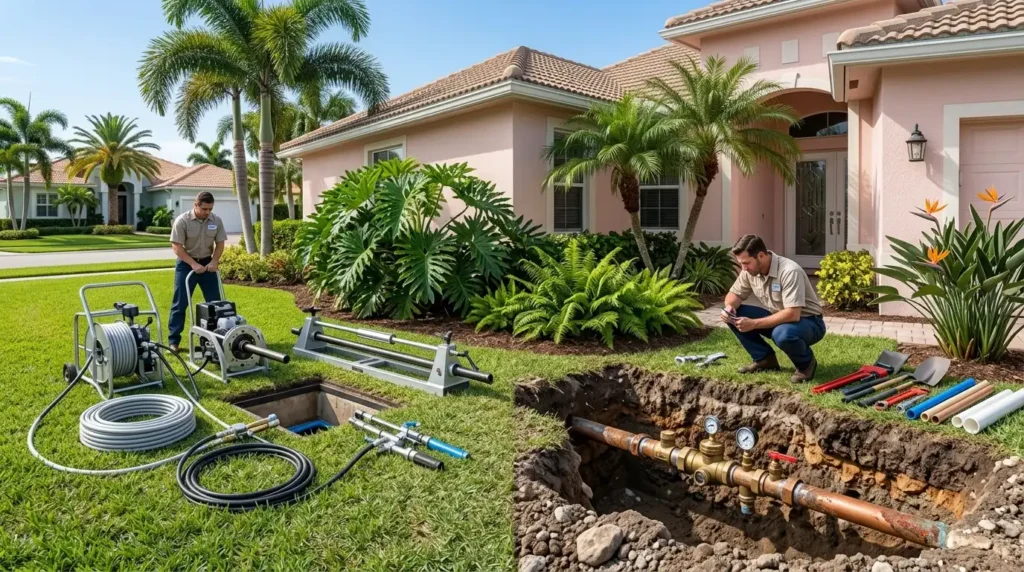
Trenchless methods replace or reroute pipe with minimal digging. Excavation opens the ground along the line. Both have a place in Miami. Coral rock and mature tree roots often decide which one fits your property.
| Method | How It Works | Yard Disruption | Best For | Limits |
|---|---|---|---|---|
| Open trench | Dig the full line route | High | Short runs under grass | Damages landscaping and pavers |
| Targeted excavation | Dig one small pit at the located leak | Low | Single isolated breaks | Needs precise leak location |
| Pipe bursting | Pull new pipe through the old one, breaking it outward | Low (two pits) | Replacing full runs under driveways | Not ideal near other buried utilities |
| Directional bore / pull-through | Bore a new path and pull in PEX or HDPE | Low | Avoiding slabs, pools, or mature trees | Coral rock can slow boring |
| Epoxy lining | Coat the pipe interior | Very low | Limited supply line uses | Must meet NSF/ANSI 61 for drinking water |
When we recommend trenchless:
- The line runs under a paver driveway, pool deck, or mature landscaping
- The full run needs replacement, not just one spot
- Soil conditions allow a clean bore path
When we recommend excavation:
- Electronic leak detection pinpoints a single break
- The line sits under open grass
- Coral rock makes boring impractical
Ask any contractor which method they plan to use and why before you sign.
DIY Repair Kits: What They Can and Can’t Do
A water line repair kit is a temporary or limited-scope fix, not a substitute for a permitted repair. Kits work well for accessible, above-ground problems. They are risky on buried lines, slab pipes, and anything behind a finished wall.
Many homeowners search “water line repair home depot Miami” hoping to avoid a service call. That instinct makes sense for a burst toilet supply hose. It makes less sense for a cracked service line two feet under coral rock.
| Kit or Product | Approx. Price | Good For | Limits |
|---|---|---|---|
| Push-to-connect coupling | $10 to $30 | Accessible copper, PEX, or CPVC breaks | Many aren’t approved for direct burial without protection |
| Stainless repair clamp with gasket | $10 to $25 | Emergency stop on a pinhole leak | Temporary only |
| Epoxy putty stick | $6 to $12 | Tiny pinhole on exposed pipe | Fails under high pressure |
| Self-fusing silicone tape | $8 to $15 | Wrapping a drip until a plumber arrives | Not a permanent seal |
| PEX crimp or clamp tool kit | $40 to $120 | Small PEX repairs and extensions | Requires correct ring sizing and technique |
| Braided stainless supply line | $8 to $20 | Replacing toilet and faucet hoses | Must match valve and fixture threads |
| Quarter-turn angle stop | $10 to $25 | Replacing a seized shutoff | Old CPVC stub-outs can crack |
DIY makes sense when:
- The pipe is exposed and accessible
- You can shut off the water at the house valve
- The job is a fixture supply line or angle stop swap
- You need a temporary stop until a plumber arrives
Call a licensed plumber when:
- The leak is underground, under the slab, or inside a wall
- The pipe is galvanized, polybutylene, or brittle CPVC
- You live in a condo where risers are shared
- The fix needs a permit or a pressure test
A clamp buys you time; it doesn’t buy you a repair. Florida’s owner-builder exemption lets you permit work on your own single-family home, but you take on full code responsibility. Keep a repair clamp and silicone tape in your garage for emergencies, then schedule the permanent fix.
Condos vs. Single-Family Homes
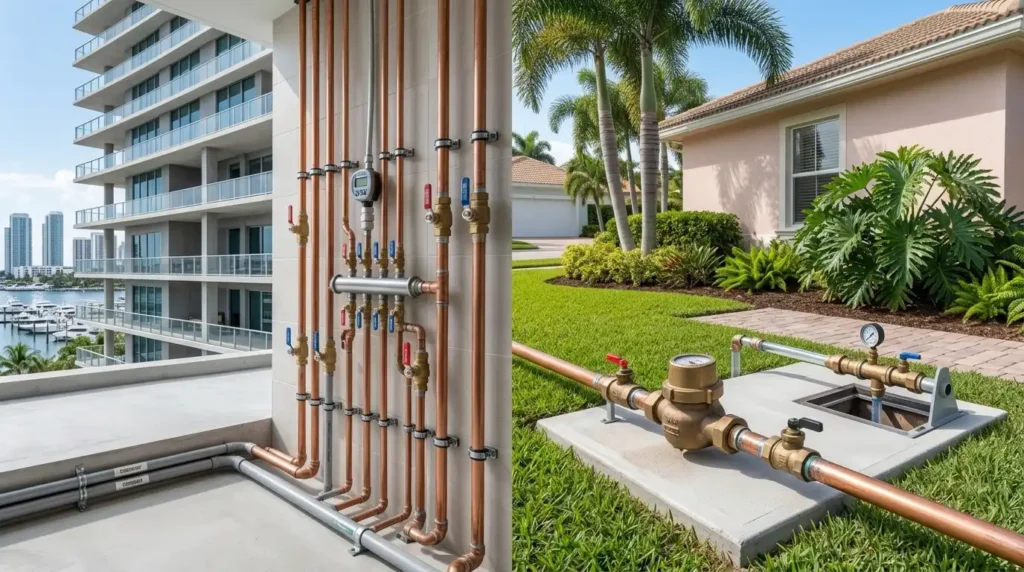
Property type changes who owns the pipe, who approves the shutoff, and how fast work can start. In Miami’s high-rises, a single leak can affect three units below within hours.
| Factor | Single-Family Home | Condo or High-Rise |
|---|---|---|
| Who owns the line | Homeowner, meter to fixtures | Owner: unit branch; Association: risers and mains |
| Shutoff control | House main valve | Unit valve, or scheduled building shutoff |
| Approval needed | Permit when required | Association approval plus permit |
| Common failure | Buried service line, slab leak | Riser corrosion, failed unit PRV, supply hoses |
| Access | Yard digging or floor access | Walls, closets, ceilings of the unit below |
| Insurance | Homeowner’s policy | Unit owner’s HO-6 plus master policy |
Before any condo work, we confirm whether the pipe serves only your unit or a shared riser. Check your association’s governing documents for a maintenance responsibility chart before you call anyone.
Water Line Repair Miami: What We See by Neighborhood
Neighborhood age and location shape the problems we find. Coastal areas fight salt. Older inland areas fight aging materials. Newer developments see construction damage and pressure issues.
| Area | What Our Crews Often Find |
|---|---|
| Miami Beach, Surfside, Sunny Isles | Salt corrosion, high water table, condo riser failures |
| Brickell and Downtown | High-rise riser issues, failed unit PRVs, supply hose bursts |
| Coral Gables and Coconut Grove | Galvanized lines, banyan and ficus roots, coral rock |
| Kendall and Westchester | Polybutylene and aging CPVC in 1970s to 1990s homes |
| Hialeah and Miami Springs | Older slab homes with galvanized and early copper |
| Little Havana and Allapattah | Aging duplex plumbing, shared lines, pinhole copper leaks |
| Pinecrest and Palmetto Bay | Long service runs on large lots, root intrusion |
| Doral | Newer PEX systems, high pressure, construction-related damage |
| North Miami and North Miami Beach | Aging copper near Biscayne Bay |
Our Local Gov Certified team works across all of our Miami-Dade service areas, and we adjust our approach to each neighborhood’s soil, housing age, and building rules. Tell us your zip code and the year your home was built when you call.
Permits and Miami-Dade Code Requirements
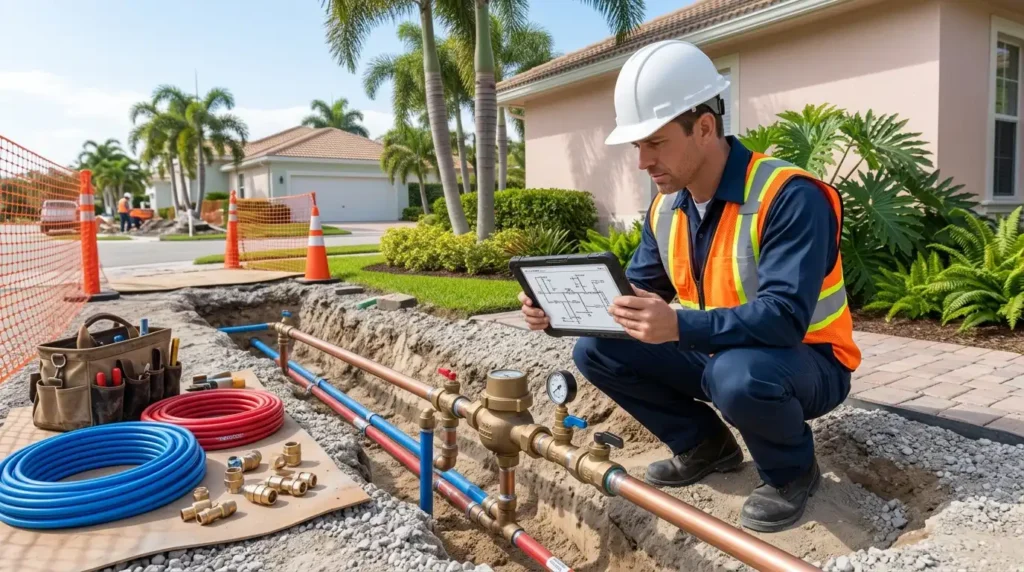
Permit rules depend on scope and jurisdiction. Miami-Dade exempts certain minor plumbing repairs. Replacing concealed or buried piping generally requires a permit. Cities like Miami, Miami Beach, and Coral Gables run their own building departments, while unincorporated areas use the county.
| Work Type | Permit Typically Required? | Notes |
|---|---|---|
| Replacing a toilet or faucet supply line | Usually no | Considered minor repair |
| Replacing an angle stop valve | Usually no | Minor repair in most jurisdictions |
| Spot repair on exposed pipe | Often no | Confirm with your city |
| Replacing concealed or under-slab piping | Usually yes | Inspection required |
| Full service line replacement | Usually yes | Material and depth must meet code |
| Whole-home repipe | Yes | Pressure test and inspection |
| PRV installation | Varies | Required when static pressure exceeds 80 psi |
Code points we verify on every job:
- Approved materials for potable water
- Proper burial depth and bedding for service lines
- Pressure-reducing valve when static pressure exceeds 80 psi under the Florida Building Code
- Backflow protection where required
- Pressure test before the line goes back into service
Ask your contractor to show the permit number before work starts.
Bathroom Supply Lines: The Parts That Fail First
Bathroom supply components fail before the main line does. A burst toilet supply hose releases water at full line pressure, and in a second-floor bathroom or condo, it reaches the ceiling below within minutes. This is the most preventable flood we respond to.
| Component | Typical Lifespan | Warning Sign | Fix |
|---|---|---|---|
| Braided stainless toilet supply line | 5 to 8 years | Bulging, rust at the nut, frayed braid | Replace with a new braided line |
| Plastic or vinyl supply line | 5 years or less | Cracks, discoloration | Replace with braided stainless |
| Multi-turn angle stop | 10 to 20 years | Seized handle, drip at the stem | Upgrade to a quarter-turn valve |
| Toilet flapper | Replace at least every 5 years | Phantom flushing, dye test failure | Replace the flapper |
| Shower valve cartridge | 10 to 15 years | Drip from the head, temperature swings | Replace the cartridge |
| Water heater connectors | About 10 years | Corrosion at the fittings | Replace the connectors |
A supply line fix is also the right time to upgrade fixtures. Miami-Dade WASD offers rebates on qualified high-efficiency toilets, faucets, and showerheads.
| Fixture | Federal Maximum | WaterSense Labeled |
|---|---|---|
| Toilet | 1.6 gallons per flush (GPF) | 1.28 GPF or less |
| Showerhead | 2.5 gallons per minute (GPM) | 2.0 GPM or less |
| Bathroom faucet | 2.2 GPM | 1.5 GPM or less |
Check the date stamped on your toilet supply hose nut tonight; if it’s older than five years, replace it.
Miami-Dade Concealed Leak Bill Adjustments
WASD offers an Underground/Concealed Leak Adjustment Request for leaks you couldn’t reasonably see. A concealed leak is one hidden underground, under a slab, or inside a wall. Visible leaks, like a running toilet, generally don’t qualify.
- Document the leak. Photograph meter readings, wet areas, and the exposed break.
- Get the leak repaired promptly. Delays can affect eligibility.
- Keep the plumber’s invoice. It should list the leak location and repair date.
- Submit the adjustment request to WASD with your documentation.
- Track your next bill to confirm usage returned to normal.
Eligibility rules and deadlines can change, so confirm current requirements with the Miami-Dade Water and Sewer Department before you file. We provide detailed invoices with leak location and repair notes to support your request.
Maintenance Checklist for Miami Water Lines
Prevention costs less than any repair. These tasks take minutes and catch problems while they’re still small.
| Task | Frequency |
|---|---|
| Run the two-hour meter test | Every 3 months |
| Check water pressure at a hose bib | Every 6 months |
| Inspect toilet and faucet supply lines | Every 6 months |
| Dye-test every toilet | Every 6 months |
| Exercise the main and angle shutoff valves | Once a year |
| Walk the service line route for wet spots | After heavy rain and every season |
| Check irrigation zones for broken heads | Monthly in dry season |
| Replace braided supply lines | Every 5 to 8 years |
| Schedule a professional plumbing inspection | Every 1 to 2 years, or before buying a home |
Bonus steps for coastal homes:
- Inspect exposed copper near the meter for green corrosion
- Keep landscaping roots away from the line route
- Install a leak detection device with an automatic shutoff
Set a recurring phone reminder for your quarterly meter test.
How We Handle Every Service Line Job
Every job follows the same five steps. That consistency is how we keep pricing transparent and results predictable.
- Locate the leak. We use electronic leak detection, acoustic listening, and pressure testing to pinpoint the failure.
- Confirm the segment. We identify whether the problem sits in the service line, interior piping, slab, or a fixture supply.
- Quote in plain language. You get a written, upfront price with repair and replacement options explained.
- Repair to code. We pull permits when required and use approved materials suited to Miami soil and water.
- Test and walk through. We pressure test the line, check every fixture, and review the work with you.
Call us with your meter readings and we’ll tell you what they most likely mean.
Faqs:
1. Do I need a permit to fix a water line in Miami?
It depends on scope and location. Replacing a toilet supply hose or angle stop usually doesn’t require a permit. Replacing concealed piping, under-slab lines, or a full service line generally does. The City of Miami, Miami Beach, Coral Gables, and unincorporated Miami-Dade each have their own building departments, so confirm with yours before work starts.
2. Is trenchless better than digging for a Miami service line?
Trenchless is better when the line runs under a driveway, pool deck, or mature trees and the full run needs replacement. Targeted excavation costs less for a single located break under grass. Coral rock can slow boring, so soil conditions often decide the method.
3. Can a DIY kit from the hardware store fix my leak for good?
No. Clamps, epoxy putty, and silicone tape are temporary stops. Push-to-connect fittings can make lasting repairs on exposed, accessible pipe, but many aren’t approved for direct burial without protection. Buried, slab, and in-wall leaks need a licensed plumber.
4. How much does it cost to fix a broken water line in Miami?
Most spot repairs on buried service lines run $500 to $1,800. Full service line replacement typically runs $1,800 to $5,500, and trenchless jobs often run $2,500 to $6,500. Coral rock, paver driveways, and pipe material move the number most.
5. Will Miami-Dade WASD lower my bill after a hidden leak?
Possibly. WASD accepts Underground/Concealed Leak Adjustment Requests for leaks you couldn’t reasonably see. You’ll need documentation, including a plumber’s invoice showing the leak location and repair date. Confirm current eligibility rules with WASD.
6. Why do coastal Miami homes need line repairs sooner?
Salt-laden soil and a high water table speed corrosion on copper and galvanized pipe. Sandy soil shifts and stresses rigid joints. Homes in Miami Beach, Surfside, Key Biscayne, and Sunny Isles often see failures years earlier than inland homes.
7. Who pays for water line repair in a Miami condo?
Usually, the unit owner pays for the branch serving only their unit, and the association pays for shared risers and mains. Your condo’s governing documents define the split. Shared pipe work needs association approval and a scheduled building shutoff.
8. Which Home Depot products are safe for a homeowner to use?
Braided stainless supply lines, quarter-turn angle stops, repair clamps, and silicone tape are reasonable for accessible bathroom and kitchen fixes. Always shut off the water first. Skip DIY on underground lines, galvanized or polybutylene pipe, and condo risers.
9. How long does a typical service line fix take?
Most spot repairs finish in one day. Full service line replacements usually take one to two days, plus inspection time when a permit is required. Whole-home repipes typically take several days depending on size.
10. Should I replace polybutylene or galvanized pipe before it leaks?
Yes. Polybutylene has a well-documented failure history, and galvanized steel corrodes from the inside out. Both cost less to replace on your schedule than after a burst floods a bathroom or slab.
Protect Your Home Before the Next Bill Arrives
A hidden leak gets more expensive every day it runs. Run the two-hour meter test tonight. If the meter moves, call our Local Gov Certified plumbers for leak detection, a written upfront quote, and code-compliant water line repair built for Miami’s salt, sand, and coral rock.